Why Cooking is Beneficial for Children
By Monica Worsley · Published 5 July 2015
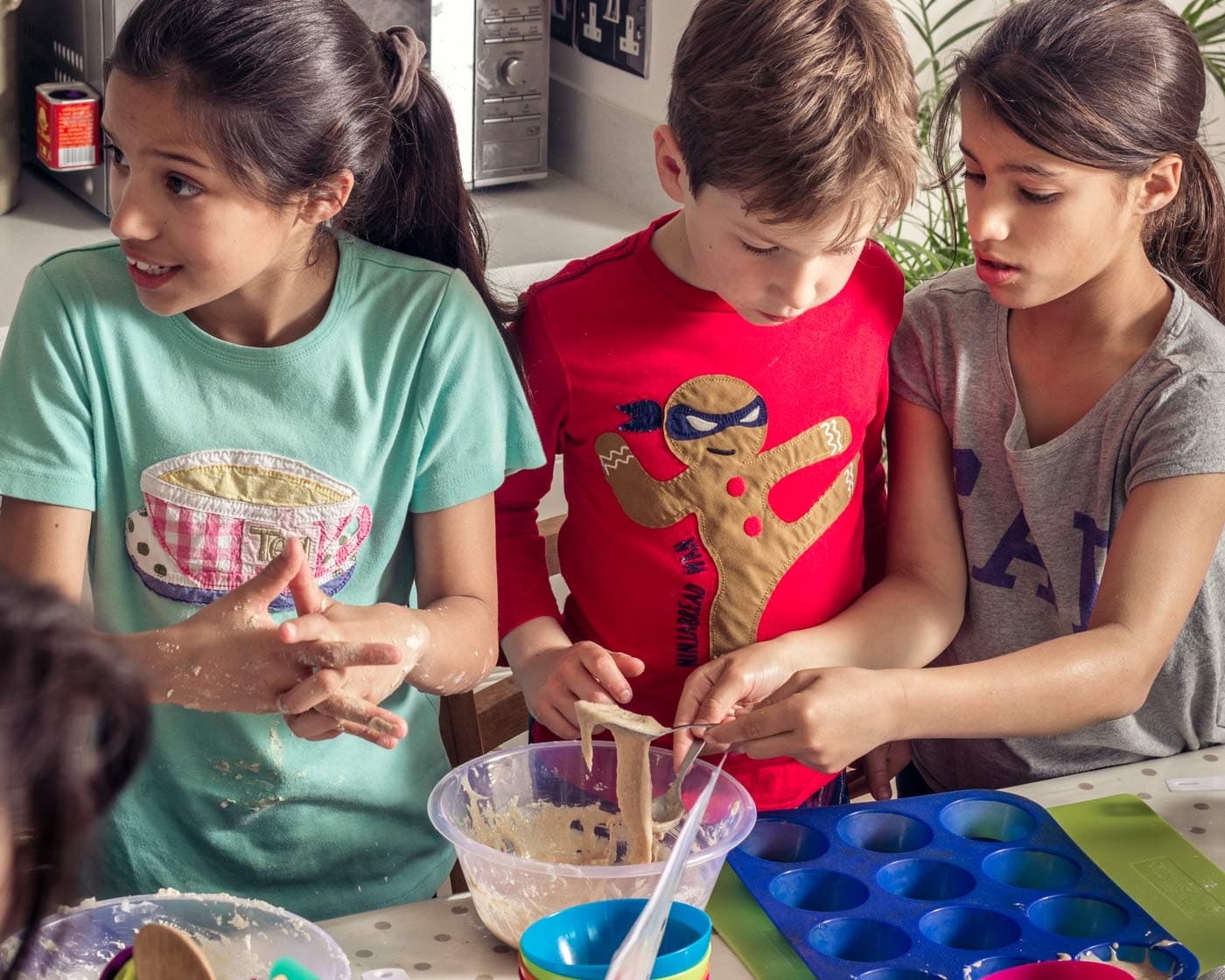
Why cooking is beneficial for children?
First of all, Cooking is fun! Most children love messing up in the kitchen, not only this means time with a grown up, but it develops and encourages most areas in their development. It helps the small brains to develop and learn a lot of new skills.Cooking provides wonderful opportunities to help children learn mathematical vocabulary. How better to learn phrases like 'more than' or 'less than' by weighing out ingredients. Allowing your child to hold a 1kg bag of sugar to feel how heavy it is, perhaps afterwards encourage them to also feel other packages, in order to help them to develop estimation skills. A child will gain experience in counting and recognising numbers. If decorations are to be added to cakes, adding a specific number and counting opportunities will arise while setting the table, even filling the dishwasher. Through the use of different cutters, children can learn the names of various 2D shapes. How many corners or sides these shapes have so that children will learn the properties of many shapes. Your child can learn about timing too, how long it takes for a boiled egg to be cooked or baking fairy cakes. Selecting easier words for young children and introducing the more difficult ones when you feel that your child is ready. Put the words into a context such as, "Which cake is bigger, yours or mine?”
Language Skills
Their language skills will also benefit from cooking, it helps children to learn many new words and concepts through discussion whilst you are cooking. Showing children what a recipe is and that they need to follow instructions in order to achieve the required result. Children will learn the names of ingredients and words like sieve, whisk, stir, mix, roll and melt. They can look for words on packets like eggs and sugar and try to find these words in the recipe.
Cooking is Science!
It is surprising just how big a part science plays in cooking. It involves the concept of changing materials: liquid cake mix becomes a solid through baking, juice can become ice lollies when frozen and chocolate melts when heated. Cooking provides an excellent opportunity to discuss where foods come from such as eggs, milk, avocados and how and where various foods grow. Children can learn many things through questions raised in the kitchen including what they need to eat to keep healthy. you can talk to them about which foods give them the energy to run and jump and which ones help them to grow strong.
It is clear that by cooking they develop their physical skills.
It is important to let children to carry out as many of the cooking tasks as possible (excluding dangerous ones where sharp knives or hot ovens are involved). Obviously if there is a lot of mixing they could begin and you can finish it off, the small ones may lack the physical ability. Tasks such as holding a spoon, mixing, beating, shaking, pouring, rolling or cutting will help to develop a child’s fine motor skills whilst encouraging them to smell and feel the ingredients will help to improve his or her use of senses.
Emotional and Social Development
Food is also part of cooking, it is a really good vehicle for communication. Children can learn to share and how to take turns, particularly if they make something with a friend or sibling. Then when the cooking is over, they will sit down and enjoy eating together. Eating a meal in company is one of the most sociable things that humans can do, after all we all need to eat in order to survive.
Cooking can help with their knowledge of Geography and History.
Children are very curious human beings from they they are born, they learn by copying and asking questions, they can learn where the different foods come from, which countries do they grow in, and in which continent we can find these countries, these foods or ingredients. Food has also a place in History, as an example you can talk about the rationing during the war or what the Victorians used to eat and cook.
Children will learn about safety in the kitchen during food preparation.
They understand about the importance of safety when dealing with food and utensils, hot ovens and even water spilt on the kitchen floor. Working with other children will give children a sense of sharing and cooperation and an understanding of how to interact with others in groups. They will be able to learn from one another. Their emotional development and self-esteem can also grow – As children learn to make something for themselves, developing a sense of independence, pride and a positive self-image.
Why take part in a cooking class?
Besides from having fun and learning new skills which will awake their imagination, curiosity and the develop all their senses – Through tasting, hearing, touching, smelling and seeing, children will be exposed to and identify different food. Being actively involved with food in the kitchen will help large and fine motor skills. As well as with food preparation which enhances eye-hand coordination.
Finally, ask your child to help you to cook, if you do not have time (or do not like it) then enrol them into cookery lessons. Most noteworthy, in the future they will be very thankful for it.